


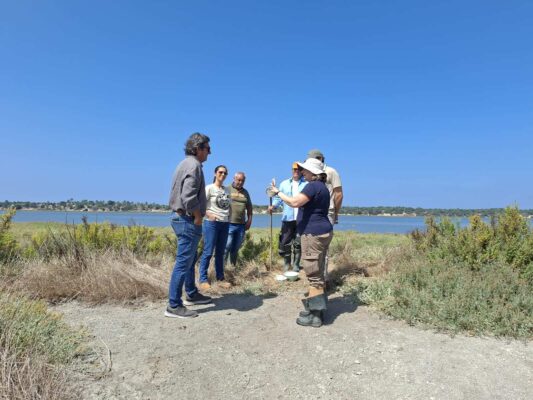







Young domestic chickens are systematically monitored in poultry farms across 180 settlements throughout the country. Monthly blood tests detect the presence of the virus in the area, enabling immediate action to be taken. The programme in Central Macedonia.
An innovative collaboration between scientists and members of the public who keep chickens in the Greek region is at the forefront of epidemiological surveillance for the presence of the West Nile virus. In Central Macedonia, 250 one-month-old chicks are brought into 50 privately owned poultry houses every April for rearing.
Blood samples are taken three times during the summer and analysed in the laboratory to detect and quantify the presence of antibodies against the virus in the birds. The result of the analysis is a reliable indicator of the circulation of the virus in the specific area. A high seropositivity rate provides an immediate signal to intensify mosquito control measures locally, focusing on larviciding and limited-scale residual adulticide treatments.
These specific interventions, together with the trapping and analysis of the infectivity of the mosquitoes themselves, as well as tens of thousands of larviciding operations in the field, form the ‘core’ of the mosquito control programme in the Region of Central Macedonia, the largest in the whole country. This year, transmission to humans is characterised as moderate in intensity, in an area that is a ‘hotspot’ for the West Nile virus, both nationwide and beyond.
How chickens ‘signal’ the danger
Domestic birds are a very reliable source of information regarding the circulation of the virus in an area. Unlike wild birds, they do not develop high rates of viraemia and therefore do not constitute a source of infection for mosquitoes. Thus, using simple serological methods, it is possible to determine whether and to what extent they have come into contact with the virus in the recent past, through bites from infected mosquitoes.
Ecodevelopment, the contractor of the mosquito control programme in Central Macedonia, has been developing an epidemiological surveillance network for WNV since 2010, initially using pigeons as sentinel animals, in collaboration with pigeon loft owners, and subsequently replacing them with young domestic chicks under six months of age. Since then, this network has expanded to 180 settlements across four regions of the country (Central Macedonia, Thessaly, Western Greece and Crete), with a total of approximately 900 chicks.
These chicks are given free of charge in early spring to dovecote owners and undergo three blood samples during the summer (June, July, August). As Ms Stella Kalaitzopoulou, biologist and head of the mosquito control programme in Central Macedonia, the analysis of the samples (using the ELISA method) shows how immunity develops due to the presence of the West Nile virus in mosquitoes in these specific areas.
Seropositivity quantifies the presence of the virus over time series. A high prevalence in the first cycle (in June) triggers an alert and leads to an intensification of mosquito control spraying locally, specifically to target the larval stage.
Mosquito traps and interventions in residents’ gardens
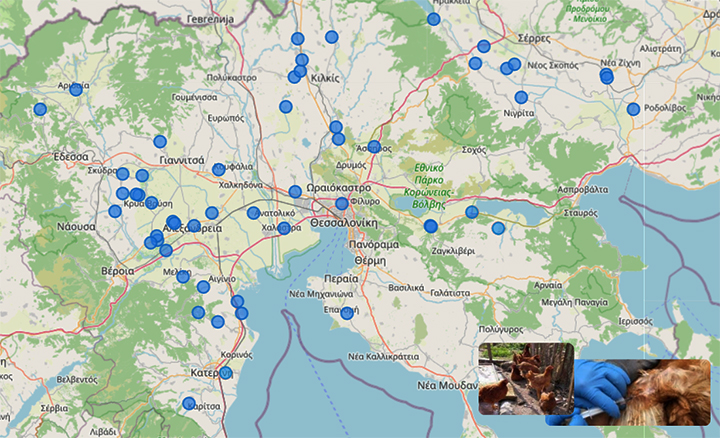
In Central Macedonia, epidemiological surveillance comprises a total of 120 monitoring points. Fifty of these involve chickens – indicator species – in chicken coops, spread across an equal number of villages. At a further 70 locations, there are special traps for capturing adult mosquitoes. These are identified in order to isolate mosquitoes of the species Culex pipiens, which is the main vector of the West Nile virus. They are then divided into groups of 50 individuals and undergo molecular analysis (PCR). Based on the proportion of infected mosquitoes, quantification and risk assessment are carried out, so that field interventions can be implemented to the extent deemed necessary.
Consequently, ‘door-to-door’ interventions are carried out every year in the gardens of 30,000–40,000 homes across 100 high-risk settlements in the Region; these include public awareness campaigns, the elimination of breeding sites, and larviciding and adult control measures, with a focus on wells and septic tanks.
The programme’s philosophy follows the principles of the One Health approach, with real-time monitoring of risk factors and immediate intervention where necessary.
Moderate transmission to humans
This year’s summer season has been characterised by moderate circulation and transmission of the virus to humans in a region that, in most years, has been at the epicentre, due to specific conditions (favourable hydrometeorological and geomorphological conditions, extensive wetlands and rice paddies, etc.) that favour the development of mosquitoes and viral load.
Based on an analysis of time-series data on the circulation of the pathogen in sentinel animals and mosquitoes, the mosquito control project contractor predicts that the moderate level of virus transmission to humans will continue until the end of September. For the period as a whole, cases of West Nile virus in humans are expected to be around 60% of the average for the last eight years.
Holistic management
The Region of Central Macedonia was the first in Greece to adopt a holistic management approach, through a range of measures at both organisational and operational levels.
“Since April, our teams and supervisors have been out and about every day, carrying out ground and aerial spraying, as well as preventive measures, which include testing for the virus in chickens or in mosquitoes caught in traps, so that we can identify where there are concentrations of infectious populations,” Melina Maria Dermentzopoulou, the Deputy Regional Governor responsible for Health and Social Solidarity, told iatronet.gr. Aerial spraying of the rice fields has now been completed, supplemented by emergency interventions where outbreaks are detected.
Citizens can contact the relevant authorities via a mobile app or a dedicated helpline to report any outbreaks or other matters of concern.
“Our primary concern is the protection of public health, because unfortunately we are losing lives to the West Nile virus, whilst at the same time ensuring quality of life by minimising disruption as far as possible, which can also have economic consequences for businesses,” notes Ms Dermentzopoulou, adding: “We continue to calmly advise people who are particularly vulnerable, as well as the general public, to take precautionary measures. At the same time, we call on the local authorities with responsibility in this area to take the necessary action in cemeteries, ditches and areas where stagnant water accumulates”.
You can read the article here.