







In mid-October, the first year of the three-year mosquito control projects in the Region of Western Greece and the Region of Central Macedonia will come to an end; fieldwork for these projects began in early April and early May respectively. Monitoring of the projects (sampling, spraying operations, results, vehicle fleet movements, etc.) was carried out in real time via the ebite online platform, to which users designated by the Contracting Authority, as well as relevant officials from all the municipalities in the Region, had authorised access.
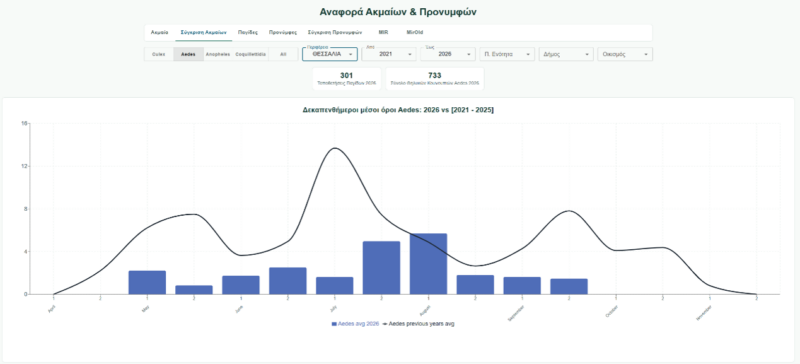
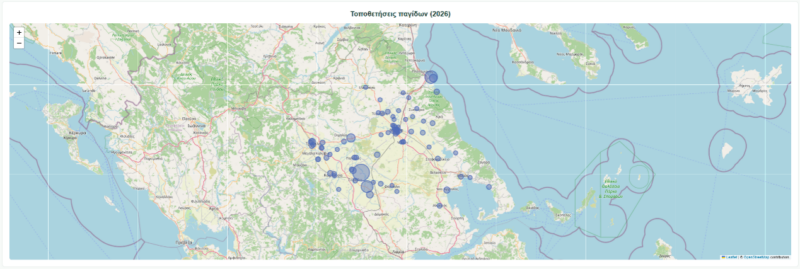
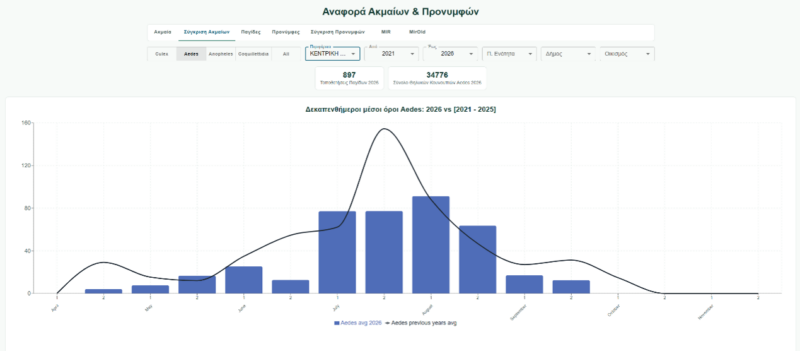
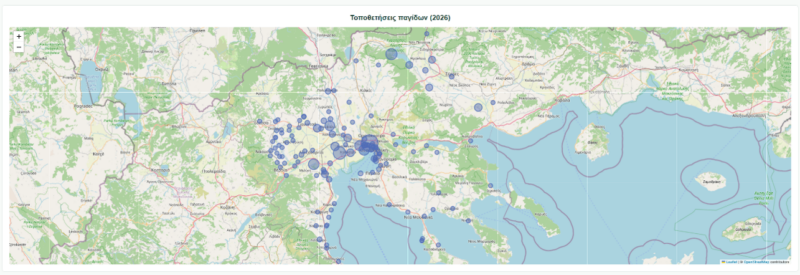
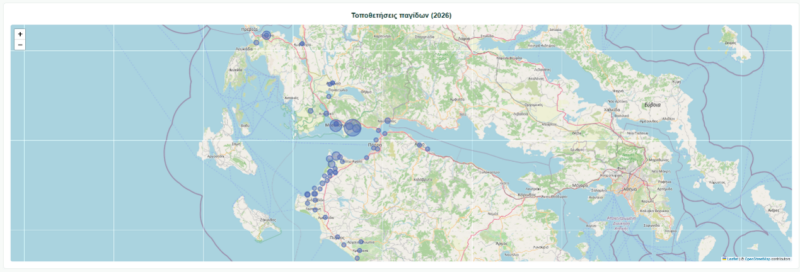
Following the completion of this year’s projects and as part of the regular publication of indicators, we present a summary of the monitoring data for adult mosquitoes of the genus Aedes for this year’s season (April–September), in the Regions of Central Macedonia, Western Greece and Thessaly. These indicators relate to the abundance of the species Aedes caspius, which is the main source of nuisance, at the adult stage, based on a total of 1,767 samples, of which 897 were taken in Central Macedonia, 569 in Western Greece and 301 in Thessaly, from 156 Ecodev trap sites. The following charts show the fortnightly average catch figures for 2026, compared with the corresponding averages for the previous five-year period. The accompanying maps show the geographical distribution of trap locations across the three regions.
Based on the data, the abundance of adult Aedes mosquitoes remained below the levels of the previous five-year period for much of the monitoring period, with variations between regions.
To evaluate the results of the projects, these indicators are assessed annually in conjunction with the interventions carried out and the environmental conditions in each region.
In the Region of Central Macedonia, values were generally lower in spring and June, whilst the highest catches were recorded in July and August. During the second fortnight of July, this year’s figure was approximately half the average for the last five years. By contrast, during the first fortnight of July and the second fortnight of August, the figures were in line with the five-year average. In September, a marked decline was recorded, with figures falling below the five-year average.
In the Region of Western Greece, from mid-June to the end of September, prices remained below the corresponding five-year averages. The increase in the second half of July was limited to around half the reference price, whilst prices were particularly low in August as well.
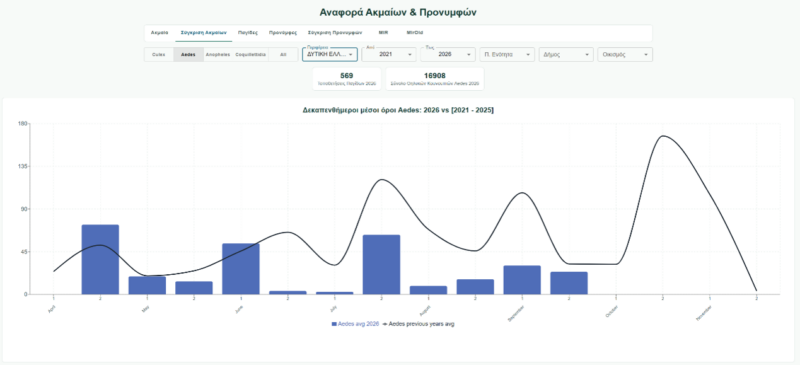
In Thessaly, values remained below the five-year averages for almost the entire period. The sharp rise typically observed in the first mid of July, as recorded in historical data, was not observed this year. This year’s highest reading was recorded in the first mid of August, close to the corresponding five-year average, and was followed by a decline.