


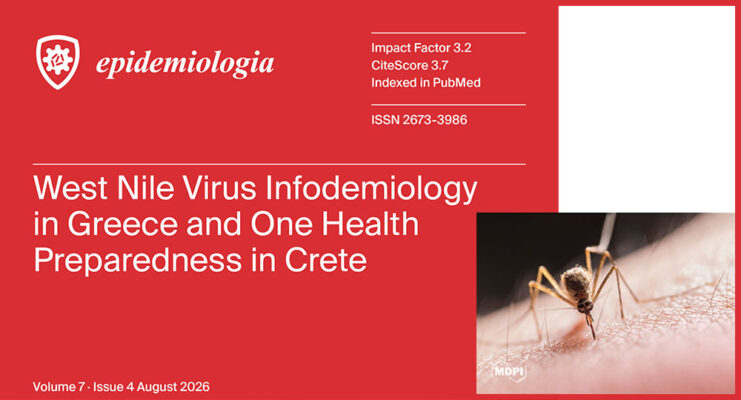


A new scientific study, involving staff from Ecodevelopment, examines the relationship between the epidemiological activity of the West Nile virus and online searches for related information during the period 2024–2025. At the same time, it presents data from Crete as a prime example of regional preparedness based on the ‘One Health’ approach. The paper, entitled ‘Infodemiology of West Nile Virus in Greece, 2024–2025, with Descriptive One Health Preparedness Evidence from Crete’ was published in the prestigious scientific journal Epidemiologia (with an impact factor of 3.2).
Online information searches mirror epidemiological activity
The authors compared official surveillance data on West Nile virus in Greece with two online information search indicators: Google searches and views of the Greek Wikipedia page on the virus.
According to the results, 220 domestic cases were recorded in Greece in 2024 and 96 domestic cases in 2025. Views on Wikipedia showed a stronger temporal correlation with the progression of severe cases compared to Google searches. The increase in interest mainly occurred at the same time as, or shortly after, the recording of cases.
The experience of Crete and the One Health approach
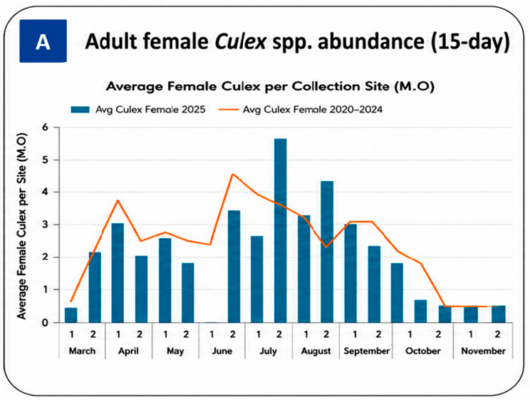
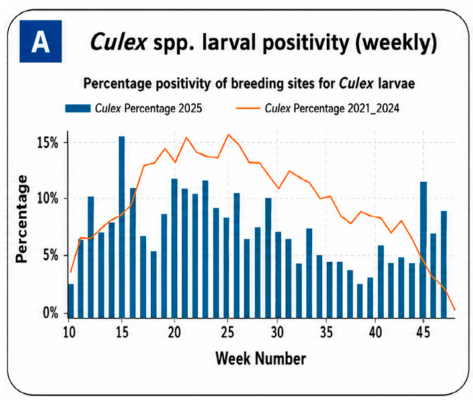
The study also presents the operational readiness of the Region of Crete, highlighting the importance of combining different sources of information. The Region’s approach includes epidemiological surveillance of human cases, entomological monitoring, molecular testing of mosquitoes, surveillance via sentinel animals (domestic poultry under 6 months of age) and the use of tools to inform the public. We would also like to take this opportunity to thank Dr Antonios Papadakis, Director-General of Public Health and Social Welfare for the Region of Crete and President of the Pan-Hellenic Union of Public Health Inspectors, for taking the initiative to draft and submit this paper to the journal.
Ecodevelopment, as the contractor for the mosquito control programme in the Region of Crete, contributed to the collection of field data and the coordination of control measures. As part of the programme, systematic sampling of adult mosquitoes is carried out, along with their identification at species level and monitoring of their population trends. EcoDevelopment’s contribution to this publication reflects the company’s ongoing commitment to scientific evidence, the importance of utilising field data, and the development of modern tools for mosquito surveillance and integrated management.
The importance of accurate information
 The key conclusion of this publication is that online trends should not replace official surveillance systems, but they can provide useful insights into how the public perceives and seeks information regarding epidemiological risk.
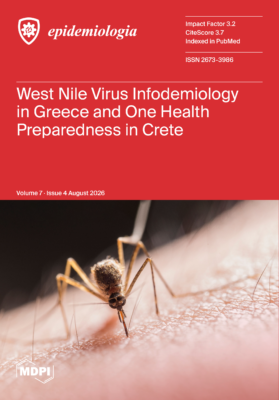
Due to its wide impact, this article made the front page of the relevant issue of the journal Epidemiologia, in which it was published. It is clear that there is a great need for the provision of timely information on public health issues, a point further supported by the fact that, following the emergence of a significant number of IDN cases in the Attica region, the quality of the relevant statements in recent times has been poor, not only from political figures but also from certain representatives of the academic community.
In light of this, we shall be launching a dedicated section on the Oikoanaptyxi website, where we will periodically publish examples of misguided public statements regarding epidemiological risk and mosquito control programmes, in order to provide the public with accurate information.