


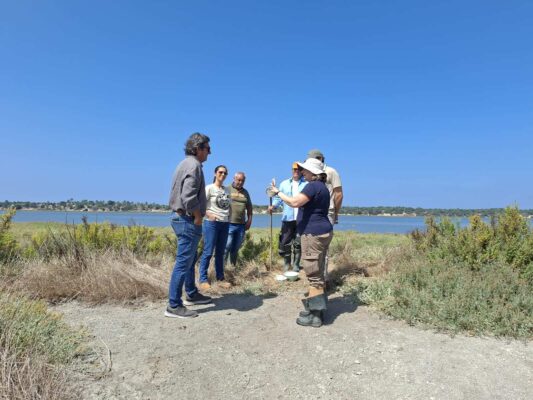








As West Nile virus spreads across Attica, with four deaths recorded within one week, experts appear cautiously optimistic about the development of the epidemiological situation in Central Macedonia.
Dr Spiros Mourelatos, biologist and founder and CEO of the organisation ‘Ecodevelopment’, which collaborates with the Region of Central Macedonia on the mosquito control programme, pointed out in a telephone conversation with us that the brunt of the outbreak is currently being felt in western Attica.
‘… We had predicted on 3 July that the Region of Central Macedonia was unlikely to see a large number of cases, something which has so far been confirmed,’ he told TyposThes.
At the same time, he pointed out that the actual extent of the spread is likely to be greater, as under-reporting is a factor. As he explained, only a small percentage of people who become infected develop symptoms, a fact that makes it difficult to accurately assess the epidemiological picture. Speaking in terms of figures, he said: “If 140 people are infected, one will show symptoms. Of those infected, 60–70% will develop encephalitis, and of those, 10% will die.”
The elderly are a vulnerable group
What should we be careful about? Mr Mourelatos emphasised that ‘we must protect the elderly, who constitute the main high-risk group. We should take greater care in our gardens, if we live outside towns, and be vigilant at night whilst sleeping, because the mosquito that transmits West Nile virus is mainly active at night and particularly whilst we are asleep’. He recommended using personal protective measures whilst sleeping, particularly plug-in insect repellents or mosquito nets. He added that insect repellents applied to the skin are effective for 1–2 hours. He also said that particular emphasis should be placed on protecting people in medical centres and hospitals, or those who are bedridden, from mosquitoes, noting that young and middle-aged people are not affected by the West Nile virus.
When asked whether there was a possibility of further spraying in the Central Macedonia region, he explained that ‘so far, there does not appear to be any such need’. As he said, every confirmed case triggers specific operational protocols, which vary depending on whether the potential outbreak is located in an urban area or a village. In small settlements, targeted interventions can be carried out, whilst in large urban centres the options are more limited.
“We’ve done everything we needed to do over the past two months. We’re now stepping up our efforts in line with the number of cases. For example, you cannot carry out fogging operations in the centre of Athens or in western Attica, whereas in small settlements this is more feasible,” he said, adding: “After all, we are a tourist destination. It is not possible to launch drastic interventions in a tourist area.”
Exemplary cooperation in Central Macedonia
The CEO of ‘Ecodevelopment’ described the epidemiological surveillance system implemented in Central Macedonia since 2010 as exemplary.
As he described, the management of cases is based on close cooperation between the National Public Health Organisation (EODY), hospitals, the Arbovirus Reference Centre at Aristotle University of Thessaloniki, and the Region of Central Macedonia. Once each case has been confirmed, the prescribed protocols are immediately activated, with different measures being implemented in urban and rural areas.