




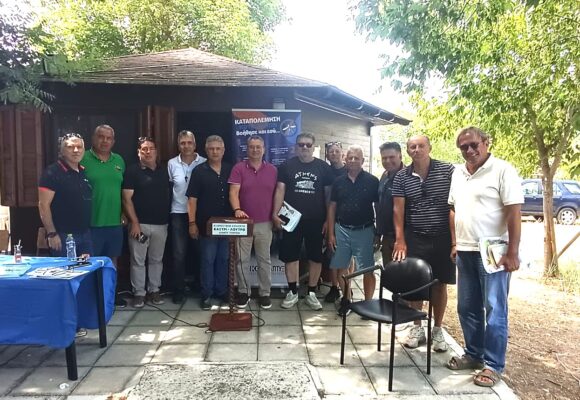
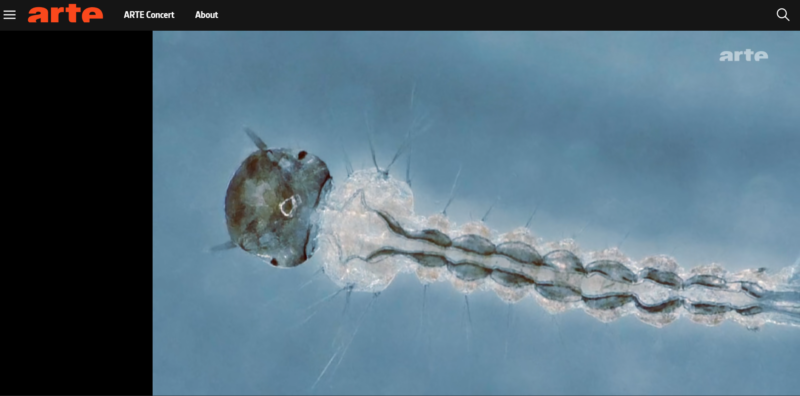


At the occasion of the launch of new three-year mosquito control projects in five regions of the country, four key decision-support tools developed by Ecodevelopment are now fully operational. In recent years, they have gradually supported project managers in their work, and this year, for the first time internationally, a new product, Ecodev Intelligence, was introduced.
It is noteworthy that as early as 2022, Spiros Mourelatos appeared on Faye Mavragani’s show “Studio with a View” on ANTENNA, at the conclusion of the Region of Central Macedonia’s three-year project for the years 2020–2022, and had already mentioned three of these: the ebite platform, the BoL forecasting model, and the Mosquito Vision app.
Between 2021 and 2025, the Ecodevelopment’s database incorporated more than 45 million field data points via the ebite platform, including 1.5 million field inspections to 50,000 mapped breeding sites to record larvae, 350,000 larvidicing applications, 30,000 adult mosquito samples, including 21,000 molecular analyses to detect the circulation of the West Nile virus (WNV) pathogen in populations of the mosquito species Culex pipiens (since 2011), and 15,500 serological tests for antibodies in young domestic chickens. These datasets are continuously enriched with meteorological and environmental data and integrated with epidemiological indicators, predictive model results, and information from Internet of Things (IoT) as part of an integrated operational decision support system (DSS).
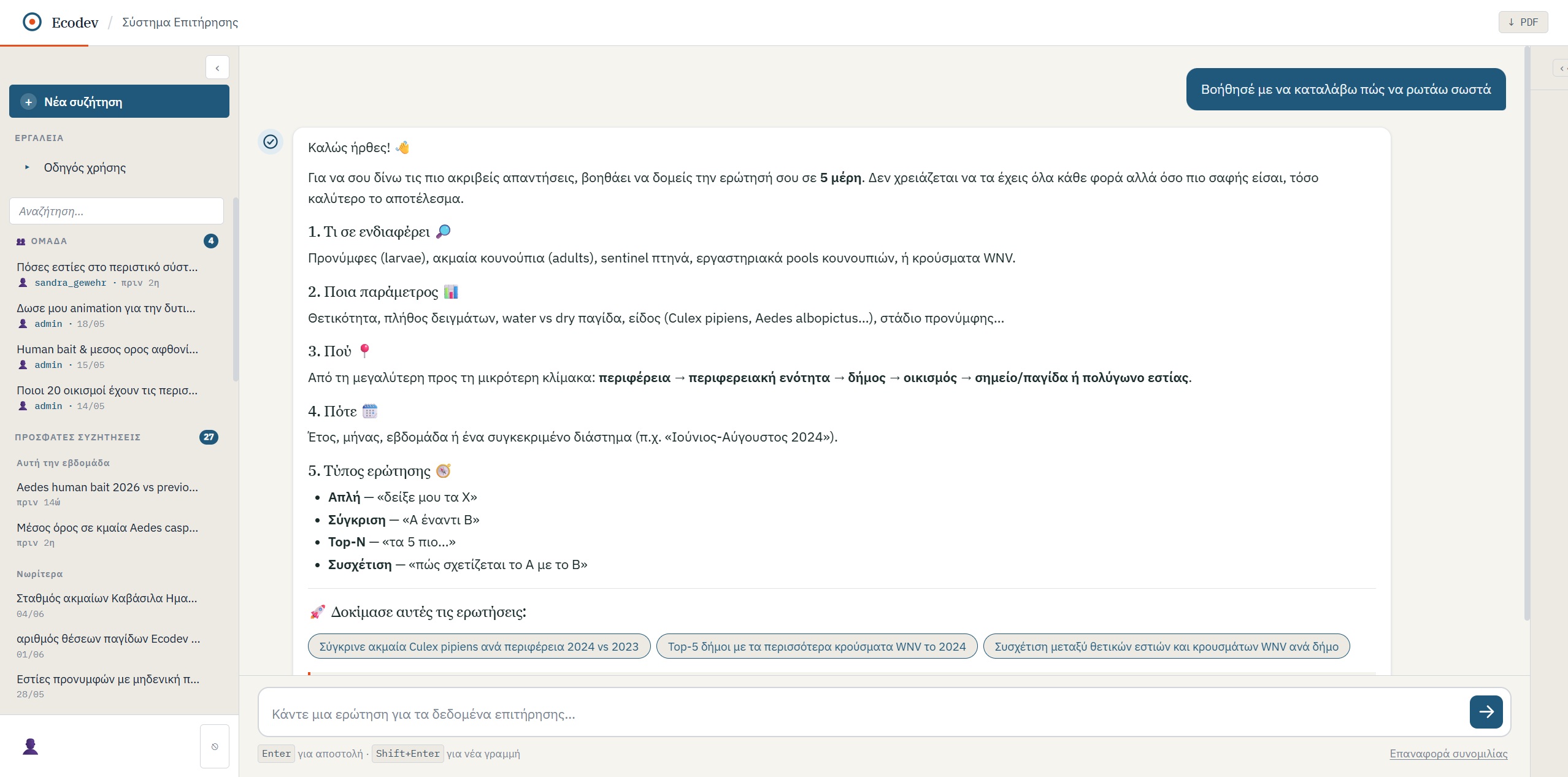 A central component is “Ecodev Intelligence,” an AI-powered interface that enables natural-language interaction with the operational mosquito monitoring databases. Users—currently limited to Ecodevelopment’s project managers—can perform real-time searches in Greek and automatically receive maps, graphs, rankings of high-risk areas, trend analyses, and operational recommendations for mosquito monitoring and the planning of control measures.
Unlike conventional monitoring dashboards, the system functions as a state-of-the-art operational decision support system (DSS), transforming monitoring data into actionable information for prioritizing interventions, plan surveillance, and coordinate operations in vastly different ecological and epidemiological settings. The operational environment itself serves as a large-scale knowledge-transfer infrastructure, where continuous feedback loops from the field iteratively improve operational information and decision-support workflows.
See here an earlier interview with Spiros Mourelatos on Faye Mavragani’s show “Studio with a View” on ANTENNA, where he discusses the initiatives and technologies that had already been in use since late 2022 in the mosquito control projects implemented by Ecodevelopment. He discussed the architecture of the ebite platform and how this architecture facilitates the prioritization of larviciding efforts at the 18,000 mosquito breeding sites in the Region of Central Macedonia, in combination with the BoL model and the Mosquito Vision application. Since then, ebite has evolved into an advanced operational decision support system, Ecodev Intelligence.